For those of you not in the loop, Roland and I decided to have a weeks holiday in Timor Leste (East Timor) during these past school holidays. The first question just about everyone asks is 'why east timor?'. The answer, because people ask that question.
Popular Australia seems to know little or nothing about this tiny country. It has a population of only 1.1 million people at last count (but rapidly growing), and the largest city, Dili, has a population of 200,000. East Timor to most Australians is a place of violence, UN missions, shootings, and recently, a potential spot for Gillards unwanted asylum seekers.
Timor Leste was a Portugese colony until 1975. When the Portugese withdrawal finished, power was handed over to an independent Timorese government. But the government did not last long. After only months in power Indonesian troops took control of the country.
There are many who believe that Australia was the best placed nation to intervene, or put pressure on the Indonesians not to invade Timor, but against a powerful and populous Suharto Indonesia, I expect Australia was practically voiceless.
Australias record has been better since. We provided peacekeeping troops during the 1999 independence election, and the turmoil that followed, and for multiple uprisings since. The presence of Australian troops in the country is still obvious in Dili where they are mostly based.
Timor is a very poor nation, with a GDP per capita of only US $542 ($2,500 ppp for those of you who know what that means). Despite that, Australia is still trying to screw them out of oil royalties for the vast reserves in the Timor sea.
In 2006 Lonely Planets estimate was that 3 or 4 travellers were arriving in the country each day. Things were a bit more rocky in 2006 than 2010, but judging by the occupancy rate of the only real backpackers in town (no more than 13 whilst we were there) not much has changed. There is no beaten path in Timor!
So why Timor?
Nobody knows much about it
Nobody much goes there
Nobody much of those that do go there (mostly UN) actually see the 'real' country
And Australia has many important connections to the place
And our adventures prove all of the above!
Sunday, July 18, 2010


Monday, May 17, 2010
ELQ - 10 April 2010
We had Easter Sunday off and it was well spent touring the sights of El Questro station (ELQ they brand themselves). We headed to ELQ after work on Saturday, it is about an hour and a half from Kununurra, but it took a bit longer as we drove most of the Gibb river road section in the dark, and half of that having a wild blind drive in a dust cloud behind people who would not let us past. The boys suggested we should turn it into a show ride. It is an unusual feeling when the first warning there is a corner coming up is a floodway sign apparently in the middle of the road, and when turning high beam on decreases rather than adds visibility.
The main reason we headed to ELQ was that it was the first of their Saturday night shows that run throughout the dry season. They put on buffet dinner if you want it, plus one of the employees, Chris Mathews busts out some good numbers on the guitar and banjo, and an old Afghan stockman called Buddy Tyson shows off his lasso-ing and whip cracking skills. The place was packed with Kununurra and Wyndham people, and the Swinging Arm Bar was doing a roaring trade!
The party was still going at 6 am in the morning, people yelling, carrying on, and playing music. Needless to say there were a few sore heads being soothed at the warm Zebeedee springs that morning.
I went with Phil, Torsten, and Christian. Phil is one of the workers up here, he is a farm boy from Morree NSW, and arrived early in the week. They have an irrigated farm with cotton when they have enough water plus chickpeas, mungbeans, soybeans, wheat and assorted other crops. Torsten is from an average sized 30ha farm in northern Germany, and is here for the season before he goes home to finish is agricultural machinery apprenticeship. I went to uni with Christian, and he is in the proccess of taking over the farm from his dad.
We checked out Chamberlain and Emma Gorge also, but the boys were not keen to do the 8K walk in to Amalia gorge for some reason.
The main reason we headed to ELQ was that it was the first of their Saturday night shows that run throughout the dry season. They put on buffet dinner if you want it, plus one of the employees, Chris Mathews busts out some good numbers on the guitar and banjo, and an old Afghan stockman called Buddy Tyson shows off his lasso-ing and whip cracking skills. The place was packed with Kununurra and Wyndham people, and the Swinging Arm Bar was doing a roaring trade!
The party was still going at 6 am in the morning, people yelling, carrying on, and playing music. Needless to say there were a few sore heads being soothed at the warm Zebeedee springs that morning.
I went with Phil, Torsten, and Christian. Phil is one of the workers up here, he is a farm boy from Morree NSW, and arrived early in the week. They have an irrigated farm with cotton when they have enough water plus chickpeas, mungbeans, soybeans, wheat and assorted other crops. Torsten is from an average sized 30ha farm in northern Germany, and is here for the season before he goes home to finish is agricultural machinery apprenticeship. I went to uni with Christian, and he is in the proccess of taking over the farm from his dad.
We checked out Chamberlain and Emma Gorge also, but the boys were not keen to do the 8K walk in to Amalia gorge for some reason.
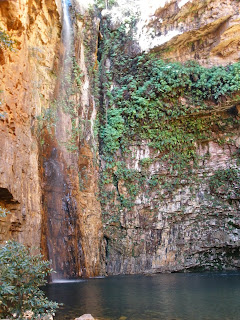
Emma gorge waterfall.
Arrived in Kununurra - 8 April 2010
Well here I am in Kununurra. I am working on a 1000 ha irrigated farm growing rock melons, honey dews, butter nut pumpkins, chickpeas, borlotti beans, and chia.
The first plantings of melons will be harvested in a months time, and I am sure there will be plenty of seconds to eat especially if the birds get stuck into the paddocks!
At the moment we are flat out cultivating - to kill weeds and help reform flat topped beds that have been rounded, and the furrows in-filled, by wet season rain; fertilising - with an initial hit of a compound fertiliser that is placed in two bands within each bed; power harrowing - to break up large clots of dirt and form a fine seed bed; and bed shaping - to form neat, flat topped, level beds that are ready for planting into.
Yesterday we go hit by a thunderstorm at 3:30 in the afternoon. It was very isolated, drenching one side of the farm but barely touching the other, and it was enough to put us back a bit. The farming systems up here are based on a dry dry season, any rain is detrimental, and the black clay very quickly turns to a deep bog after a little rain, keeping tractors out of the paddocks.
But despite the inconvenience rain makes everybody smile!

Mud and an African Mahogany out the front of our house.
Sunday, December 13, 2009
Charlie Wilson's War
Yesterday I watched Charlie Wilsons War. It is a film from 2007, based on George Crile's book, Charlie Wilsons War: The extraordinary story of the largest covert operation in history. Charlie Wilson is a United States congressman from Texas who likes spirits and women. A wealthy Houston socialite named Joanne Herring convinces him to visit Pakistan where he sees the refugee camps packed with Afghans fighting for food aid. They are refugees from the Russian occupation at the behest of the marxist government of Afghanistan, and have fled to the North-West Frontier province, chiefly the city of Peshawar (If you have been listening to the news this year you will have heard Peshawar and the North-West Frontier province mentioned in relation to the Taliban).
Disturbed by what he has seen Charlie Wilson sets about using his unique position on secret defense related councils to buy soviet weapons from the Israelis and Egypt in conjunction with Saudia Arabia, to provide to Pakistan to arm the mujahideen (warriors of the jihad) in Afghanistan. This was during the Cold War, so America could not be seen to be assisting the mujahideen, hence Soviet arms were used initially, they were funneled through Pakistan, and very few people knew about it. The mujahideen began to shoot down the Russian helicopters and fighter jets that would previously strafe villages and valleys unopposed. In 1989 the last of the Russian Army left Afghanistan.
As everybody celebrates, the CIA officer running the operation hands Charlie Wilson an NIE about "the crazies starting to roll into Kandahar". (National Intelligence Estimates describe what the intelligence services expect to happen in the future. RANDOM SLIGHTLY OFF TOPIC POINT: Kandahar is an alteration of Alexander, the city was named after Alexander the Great, one of the many to invade Afghanistan (none of them particularly successful)). The CIA agent, Gust also says "Start with the roads, move on to the schools, restock the sheep herds, give 'em jobs, give 'em hope." Charlie says "I'm trying." and Gust says "Try harder."
So Charlie tries to convince the necessary people that they need money to rebuild the country, but it falls on deaf ears. The movie ends with Charlie Wilson receiving a military honour. And, in typical black screen, white-text style
"These things happened. They were glorious and they changed the world…
and then we fucked up the end game."
Charlie Wilson
And that, I believe, is where the real lesson lies. The fact that the movie was written by Aaron Sorkin, of West Wing fame, pretty much confirms that.
But not everybody would draw that conclusion, and here we become mired in politics and American foreign affairs for a bit. Michael Johns, a foreign policy analyst and speechwriter for Ronald Reagan writes on his blog that "the Reagan-led effort to support freedom fighters resisting Soviet oppression led successfully to the first major military defeat of the Soviet Union" "Afghanistan, quite simply, proved for the first time that, with determination and support, the Soviet Union's conquests were reversible. The global significance of this message surely ranks among the most important of the 20th century"
He complains that Republican senators committed to supporting resistance movements in Soviet occupied countries have not been recognised by history despite the fact that they "sacrificed political popularity to fight these battles".
Johns also says that Mikhail Gorbachev said Afghanistan was a bleeding wound for the USSR, and that "It was a bleeding wound because the Reagan army bravely stood against that Soviet occupation and consciously made it one, not just in Afghanistan but in almost every non-European nation where the Soviets sought to impose their will on people. It is late 20th century resistance that won the Cold War, and it is Reagan and the Reagan army that made that resistance against a ruthless global superpower possible."
But nowhere in his analysis entitled Charlie Wilson's War Really was America's War, does he mention the fact that the USA provided only money to the Afghans, that it was their bravery to continue fighting, after their villages had been mercilessly strafed, and people forced to lie on the ground whilst tanks ran them over, that caused the Russians to leave Afghanistan. Nor does he mention that Saudi Arabia matched American funds 1:1. I also doubt the mujahideen saw themselves as the "Regan Army". But, all in all it is a well written strongly Republican biased piece.
Finally Johns gets around to discussing the aftermath of the Russians exit.
"Unable to maintain a consensus for some continued nation-building following the Soviets' nine-year occupation, as advocated by most of the Reagan army of mujahideen supporters, the Taliban ultimately arose to fill the power vacuum left by the Soviets, making Afghanistan the breeding ground for al-Qaeda training and leading to what has become this nation's current conflict against global terrorism. Does there not exist a contemporary lesson in this? It seems impossible, if we are a nation given to learning even history's most recent lessons, not to see that U.S. post-Saddam engagement in Iraq, costly as it has been, is rooted in not making a similar mistake to the one made in Afghanistan. Had the U.S. committed just several years to help Afghanistan and its people rebuild following its 1989 liberation, what might be the state of this world today? But U.S. neglect of post-occupation Afghanistan, especially under the Clinton administration, invited a worst possible outcome, which ultimately arrived on September 11, 2001."
"the defeat of the Red Army in that conflict stands as one of the great successes of U.S. engagement in the world, sending a hugely important global signal to the Soviets and the world that the future did not belong to Moscow's totalitarian aspirations. The future belonged to those who resisted it. This change of current is at the heart of the West's Cold War victory."
Now lets get the timelines of US presidents and world events clear and you will see just how much the USA learns from history!
1977 Jimmy Carter
1978
1979 Russian army begins deployment in Afghanistan
1980
1981 Ronald Regan
1982
1983
1984
1985
1986
1987
1988
1989 George H. W. Bush - Russian withdrawal from Afghanistan complete
1990 Sadam Hussein invades Kuwait
1991 US forces attacked and defeated, the Iraqi army in Kuwait and parts of southern Iraq, and then left
1992
1993 Bill Clinton
1994
1995
1996
1997
1998
1999
2000
2001 George W. Bush - US troops deploy to Afghanistan
2002
2003 US troops invade Iraq
2004
2005
2006
2007
2008
2009 Barack Obama - US troops remain in Afghanistan and Iraq.
George H. W. Bush (and to a much lesser extent 4 years latter Bill Clinton) was the president responsible for not investing in the rebuilding of Afghanistan, leaving it empty for 'the crazies to start rolling in", which they clearly did. Hence George W. Bush went off to war again to try and get rid of the "crazies" his father let thrive, with no plan for the post-war reconstruction his father forgot about. Hence we are still there fighting a stronger insurgency than at the start of the war.
George H. W. Bush left Iraq at an appropriate time, but clearly W. Bush thought he should have stayed, and 12 years later he was back on the pretense of destroying Saddam's non-existent "Weapons of mass destruction". The new investigation in the UK into why they went to war will probably lay this all bare.
So we were back in Iraq with the US, we pulled Saddam's statue over, and thought we would be leaving. Again, with absolutely no exit strategy, or thought to reconstruction the country was not stable enough for a withdrawal, and more than 6 years later we are still there.
Clearly we fucked up the end game, and are intent on doing it over and over again.
Who knows whose home we will fuck up next….
Disturbed by what he has seen Charlie Wilson sets about using his unique position on secret defense related councils to buy soviet weapons from the Israelis and Egypt in conjunction with Saudia Arabia, to provide to Pakistan to arm the mujahideen (warriors of the jihad) in Afghanistan. This was during the Cold War, so America could not be seen to be assisting the mujahideen, hence Soviet arms were used initially, they were funneled through Pakistan, and very few people knew about it. The mujahideen began to shoot down the Russian helicopters and fighter jets that would previously strafe villages and valleys unopposed. In 1989 the last of the Russian Army left Afghanistan.
As everybody celebrates, the CIA officer running the operation hands Charlie Wilson an NIE about "the crazies starting to roll into Kandahar". (National Intelligence Estimates describe what the intelligence services expect to happen in the future. RANDOM SLIGHTLY OFF TOPIC POINT: Kandahar is an alteration of Alexander, the city was named after Alexander the Great, one of the many to invade Afghanistan (none of them particularly successful)). The CIA agent, Gust also says "Start with the roads, move on to the schools, restock the sheep herds, give 'em jobs, give 'em hope." Charlie says "I'm trying." and Gust says "Try harder."
So Charlie tries to convince the necessary people that they need money to rebuild the country, but it falls on deaf ears. The movie ends with Charlie Wilson receiving a military honour. And, in typical black screen, white-text style
"These things happened. They were glorious and they changed the world…
and then we fucked up the end game."
Charlie Wilson
And that, I believe, is where the real lesson lies. The fact that the movie was written by Aaron Sorkin, of West Wing fame, pretty much confirms that.
But not everybody would draw that conclusion, and here we become mired in politics and American foreign affairs for a bit. Michael Johns, a foreign policy analyst and speechwriter for Ronald Reagan writes on his blog that "the Reagan-led effort to support freedom fighters resisting Soviet oppression led successfully to the first major military defeat of the Soviet Union" "Afghanistan, quite simply, proved for the first time that, with determination and support, the Soviet Union's conquests were reversible. The global significance of this message surely ranks among the most important of the 20th century"
He complains that Republican senators committed to supporting resistance movements in Soviet occupied countries have not been recognised by history despite the fact that they "sacrificed political popularity to fight these battles".
Johns also says that Mikhail Gorbachev said Afghanistan was a bleeding wound for the USSR, and that "It was a bleeding wound because the Reagan army bravely stood against that Soviet occupation and consciously made it one, not just in Afghanistan but in almost every non-European nation where the Soviets sought to impose their will on people. It is late 20th century resistance that won the Cold War, and it is Reagan and the Reagan army that made that resistance against a ruthless global superpower possible."
But nowhere in his analysis entitled Charlie Wilson's War Really was America's War, does he mention the fact that the USA provided only money to the Afghans, that it was their bravery to continue fighting, after their villages had been mercilessly strafed, and people forced to lie on the ground whilst tanks ran them over, that caused the Russians to leave Afghanistan. Nor does he mention that Saudi Arabia matched American funds 1:1. I also doubt the mujahideen saw themselves as the "Regan Army". But, all in all it is a well written strongly Republican biased piece.
Finally Johns gets around to discussing the aftermath of the Russians exit.
"Unable to maintain a consensus for some continued nation-building following the Soviets' nine-year occupation, as advocated by most of the Reagan army of mujahideen supporters, the Taliban ultimately arose to fill the power vacuum left by the Soviets, making Afghanistan the breeding ground for al-Qaeda training and leading to what has become this nation's current conflict against global terrorism. Does there not exist a contemporary lesson in this? It seems impossible, if we are a nation given to learning even history's most recent lessons, not to see that U.S. post-Saddam engagement in Iraq, costly as it has been, is rooted in not making a similar mistake to the one made in Afghanistan. Had the U.S. committed just several years to help Afghanistan and its people rebuild following its 1989 liberation, what might be the state of this world today? But U.S. neglect of post-occupation Afghanistan, especially under the Clinton administration, invited a worst possible outcome, which ultimately arrived on September 11, 2001."
"the defeat of the Red Army in that conflict stands as one of the great successes of U.S. engagement in the world, sending a hugely important global signal to the Soviets and the world that the future did not belong to Moscow's totalitarian aspirations. The future belonged to those who resisted it. This change of current is at the heart of the West's Cold War victory."
Now lets get the timelines of US presidents and world events clear and you will see just how much the USA learns from history!
1977 Jimmy Carter
1978
1979 Russian army begins deployment in Afghanistan
1980
1981 Ronald Regan
1982
1983
1984
1985
1986
1987
1988
1989 George H. W. Bush - Russian withdrawal from Afghanistan complete
1990 Sadam Hussein invades Kuwait
1991 US forces attacked and defeated, the Iraqi army in Kuwait and parts of southern Iraq, and then left
1992
1993 Bill Clinton
1994
1995
1996
1997
1998
1999
2000
2001 George W. Bush - US troops deploy to Afghanistan
2002
2003 US troops invade Iraq
2004
2005
2006
2007
2008
2009 Barack Obama - US troops remain in Afghanistan and Iraq.
George H. W. Bush (and to a much lesser extent 4 years latter Bill Clinton) was the president responsible for not investing in the rebuilding of Afghanistan, leaving it empty for 'the crazies to start rolling in", which they clearly did. Hence George W. Bush went off to war again to try and get rid of the "crazies" his father let thrive, with no plan for the post-war reconstruction his father forgot about. Hence we are still there fighting a stronger insurgency than at the start of the war.
George H. W. Bush left Iraq at an appropriate time, but clearly W. Bush thought he should have stayed, and 12 years later he was back on the pretense of destroying Saddam's non-existent "Weapons of mass destruction". The new investigation in the UK into why they went to war will probably lay this all bare.
So we were back in Iraq with the US, we pulled Saddam's statue over, and thought we would be leaving. Again, with absolutely no exit strategy, or thought to reconstruction the country was not stable enough for a withdrawal, and more than 6 years later we are still there.
Clearly we fucked up the end game, and are intent on doing it over and over again.
Who knows whose home we will fuck up next….
Sunday, November 15, 2009
Traveston Crossing Dam - 11 November 2009
Peter Garrett has finally used his common sense (and probably satisfied is conscience), and prevented a large environmentally damaging project from going ahead. After Anna Bligh and the QLD Water Department had spent four years or so planning, buying up 14,000 ha of 'prime' farming land (as all land that is going to be drowned by a dam is called), and trying to convince people they wouldn't be harming the endangered turtles and lungfish that live in the river, Mr. Garratt has put an end to the madness.
The Traveston crossing dam was planned for the Mary River north-west of Brisbane, near Gympie. The Mary River is one of two rivers in the world that are host to populations of Australian Lungfish. The nearby Burnett River contains the other population, and is already dammed. There is a fish-way up the dam that is meant to be best-practice. How anyone knows what best practice is when a fish-way has never been built for this species of fish before, I am not too sure. And this is no ordinary fish. Fossils identical to this species, found in NSW, have been dated at 100 million years old, and 400 million year old fossils of lungfish have been found in Australia. That makes them one of the oldest vertebrate groups still living. The lungfish is called a lungfish because it can surface and take a gulp of air, when the water it is living in becomes too deoxygenated for it to survive. I forget the physiology of it all, but I assume it has a primitive lung in addition to its gills. The ability to breath air means it can survive in small stagnant pools. The ability of ancient relatives of the lungfish to breathe air may have been one of the first steps to moving out of the water and on to land.
The best practice fish-way on the Burnett River was to be the basis of the fish-way for the Mary River. Despite there only being evidence the fish-way has carried one juvenile lungfish from bottom to top on the Burnett fish-way, any official from QLD Water will tell you it functions effectively and will not impact lungfish populations!
So Pete has put an end to a ridiculous dam, and hopefully signaled that dams should not be high on the priority list for water departments Australia wide. Indeed it is hilarious to think that QLD Water's response to low water levels in SE QLD dams over the last few years, and hence dwindling water supply, was to build another big dam in SE QLD. I hope you see the logic!
The Traveston crossing dam was planned for the Mary River north-west of Brisbane, near Gympie. The Mary River is one of two rivers in the world that are host to populations of Australian Lungfish. The nearby Burnett River contains the other population, and is already dammed. There is a fish-way up the dam that is meant to be best-practice. How anyone knows what best practice is when a fish-way has never been built for this species of fish before, I am not too sure. And this is no ordinary fish. Fossils identical to this species, found in NSW, have been dated at 100 million years old, and 400 million year old fossils of lungfish have been found in Australia. That makes them one of the oldest vertebrate groups still living. The lungfish is called a lungfish because it can surface and take a gulp of air, when the water it is living in becomes too deoxygenated for it to survive. I forget the physiology of it all, but I assume it has a primitive lung in addition to its gills. The ability to breath air means it can survive in small stagnant pools. The ability of ancient relatives of the lungfish to breathe air may have been one of the first steps to moving out of the water and on to land.
The best practice fish-way on the Burnett River was to be the basis of the fish-way for the Mary River. Despite there only being evidence the fish-way has carried one juvenile lungfish from bottom to top on the Burnett fish-way, any official from QLD Water will tell you it functions effectively and will not impact lungfish populations!
So Pete has put an end to a ridiculous dam, and hopefully signaled that dams should not be high on the priority list for water departments Australia wide. Indeed it is hilarious to think that QLD Water's response to low water levels in SE QLD dams over the last few years, and hence dwindling water supply, was to build another big dam in SE QLD. I hope you see the logic!
Tuesday, November 10, 2009
WTF - 24 October 2009
This afternoon I walked into the kitchen after bouncing around in an open air 1974 tractor slashing fire breaks all morning. There on the table, on the front page of the paper was a criminal shot of a guy I know. Arrested on suspicion of child sex offences at a summer camp in America, he was arrested at the airport as he was heading back home. I did not know what to think. I did not know whether to share my connection with everybody else in the room, or hide it, as if I had something to be ashamed of. Not sure what to do I just carried on as normal, whilst constantly debating whether to tell anyone in my adopted family what I knew. It took me almost half an hour to decide that it was ridiculous not to tell people, just because he was arrested under suspicion of child sex offences. If he was on the front page for burglary, or something good, I would not have hesitated to say I knew him. But potential child sex offences certainly made me think.
What funny creatures we are (or maybe just me).
What funny creatures we are (or maybe just me).
Sunday, October 11, 2009
Green to Gold - 4th October 2009
Everyday I lift my head from my pillow and gaze out across the vast valley in front of me to see what the days weather might hold. From out my window I can see 10 to 15 k's across the valley, down the valley 25 kms away I can see Mingenew. You can tell when people are training on the town oval at night as the two huge spotlights point right as us, glaring brighter than all the rest of the town lights. You can also see the lights of any cars on the Coalseam road almost all the way from Mingenew to the front gate.
My drive to work in Mingenew takes me down through the valley, the Nangetty valley, and past 22 kms of crop. The crops are turning, and every day brings a different shade. First the dark green of the rapidly growing crop gets more and more silvery as the wheat throws up ears with their spiky silvery green glumes that sparkle in the sun. As the grains fill, and the days get warmer and longer, the tips of the glumes wither and bleach, tipping the crop like a light dusting of snow on green fields. Slowly the flag leaves, the leaf that provides the majority of energy for the growing grains, begin to die back. Then as grain fill is completed the ears themselves turn a golden brown. If you leave for 4 or 5 days you will hardly recognise the place when you get back! Everyday I see a new colour on my way to work, and a new one on the way home!
There is another annual change from green to gold up here. I didn't watch the transition because I was here too late. I only basked in the golden yellow glow of carpets of millions of yellow pom poms that adorn all the break-aways and roadsides around the farm, and the nearby Coalseam conservation park. Once the pop poms flower come the pink and white everlastings, then an array for three or four other species of wildflowers, depending on where you look. If you have to tolerate a southern winter there is no better place to spend it than in the heart of wild flower country!
My drive to work in Mingenew takes me down through the valley, the Nangetty valley, and past 22 kms of crop. The crops are turning, and every day brings a different shade. First the dark green of the rapidly growing crop gets more and more silvery as the wheat throws up ears with their spiky silvery green glumes that sparkle in the sun. As the grains fill, and the days get warmer and longer, the tips of the glumes wither and bleach, tipping the crop like a light dusting of snow on green fields. Slowly the flag leaves, the leaf that provides the majority of energy for the growing grains, begin to die back. Then as grain fill is completed the ears themselves turn a golden brown. If you leave for 4 or 5 days you will hardly recognise the place when you get back! Everyday I see a new colour on my way to work, and a new one on the way home!
There is another annual change from green to gold up here. I didn't watch the transition because I was here too late. I only basked in the golden yellow glow of carpets of millions of yellow pom poms that adorn all the break-aways and roadsides around the farm, and the nearby Coalseam conservation park. Once the pop poms flower come the pink and white everlastings, then an array for three or four other species of wildflowers, depending on where you look. If you have to tolerate a southern winter there is no better place to spend it than in the heart of wild flower country!

Yellow pom poms growing in a fenced area. The grader is filling in the gully in an attempt to arrest the severe erosion, and revegetate the gully head. The soil is clayey. sodic, and quickly becomes very crumbly once exposed. The paddock at the top of the picture is suprisngly goos grazing country. The dark patches are bluebush (Maireana brevifolia) plants, that the sheep really take a liking to, especially when there is also some grass or straw to eat as well.
And to top it all off a flock of Budgerigars returned last week. They seem to head out to station country during the winter, and are back now to start feeding on all the seeds that have just finished filling.

Sunset in the Nangetty valley.
Subscribe to:
Posts (Atom)
